Snoring
Especially snoring with the mouth open, as the airway narrows once the muscles relax.

Myofunctional therapy retrains the way you breathe, rest your tongue and swallow. It can help with mouth breathing, snoring, jaw ache and grinding when a muscle or breathing habit is part of the cause. One approach for teenagers and adults is the Myosa® System: a soft, removable appliance worn for about an hour a day and overnight, plus a few minutes of daily exercises. Book an airway assessment at Magical Smiles Point Cook, 220 Point Cook Road, and ask our team whether it's available and suitable for you.
Myofunctional therapy takes daily effort and doesn't suit everyone, so it's worth checking early whether your symptoms fit the pattern it usually helps. These signs are common, too: the Better Health Channel estimates that around 20% of the population snores at night, and healthdirect's guide to orthodontists, last reviewed in November 2024, lists problems breathing through the mouth or snoring among the signs worth having checked.
This probably isn't the right page if your child is under ten and still growing quickly. The growth-focused version of this treatment is Myobrace® and myofunctional therapy for children.
It also isn't the place to start if you've been diagnosed with moderate or severe obstructive sleep apnoea and use CPAP. Your sleep physician leads that care, though we're glad to help with the dental side of it. The Better Health Channel's sleep apnoea page estimates that about 5% of Australians have sleep apnoea, and healthdirect's guide, last reviewed in June 2024, notes that you may need a referral to a sleep clinic for an overnight sleep study.
If snoring is the main thing you want treated, our snoring and sleep apnoea page explains the other options, including oral appliances and laser snoring treatment.
Few people have had this explained, and it's worth two minutes because everything in the treatment builds on it.
Your nose warms, moistens and filters air before it reaches your lungs. Nose breathing also keeps your lips gently closed and your tongue resting against the roof of your mouth, which is where the upper jaw gets much of its support.
When mouth breathing becomes a habit, the tongue stops resting against the palate and sits lower and further back. The muscles that hold it up do less work, and the lips lose their easy seal. None of this is obvious day to day; it simply starts to feel normal.
Lying down, with every muscle relaxed, a low-resting tongue has further to fall. It narrows the space at the back of the throat, air has to squeeze past, and the soft tissue vibrates. That vibration is snoring. Mouth breathing at night is one of the things a sleep assessment looks at.
Most people come to us about the end of the chain: the sore jaw, the snoring or the headaches. Treatment works further back, on the habit that started it.
It often starts with something that has long since passed, such as a blocked nose in childhood, allergies or large tonsils. The cause goes away, but the habit stays.
Without a lip seal, the tongue loses its place against the palate. The muscles that held it there get less use and gradually weaken.
We swallow hundreds of times a day without thinking. When the tongue can't lift properly, the lips and cheeks help out, pressing inward over and over for years.
That altered pattern puts extra work on the jaw joint and the muscles around it. Over time it can show up as clicking, tightness, headaches and tooth wear.
That's why a nightguard can protect your teeth while the grinding, tiredness or jaw tension carries on. A guard manages the result of the habit; myofunctional therapy works on the habit itself. Many people benefit from both.
Myosa® is made by Myofunctional Research Co, the Australian company that also makes Myobrace®. Treatment has two parts, and the second one matters most.
A short film showing the appliance, the airway and the daily exercises that go with it.
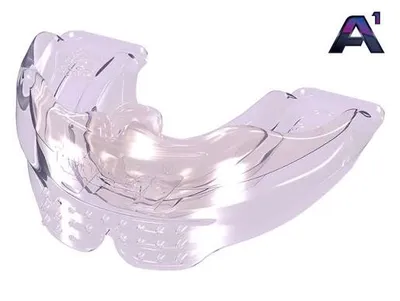
The Myosa®A1 — soft, clear and removable. No brackets, no wires, nothing fixed to your teeth.
Image is indicative only. Whether an appliance suits you, and which one, depends on your individual needs and what an assessment finds.
A soft, removable appliance, worn for about an hour a day and overnight while you sleep.
Nothing is bonded or wired to your teeth, and you put it in and take it out yourself. The appliance holds your lower jaw slightly forward, which can help keep the airway more open, and guides your tongue and lips towards a better resting position.
Worn for around an hour in the day and through the night. It gently opens the bite, brings the lower jaw forward and gives the tongue a correct place to rest while you're busy with something else.
A short set of guided breathing and muscle exercises each day. This is the part that makes the change last, rebuilding nose breathing, lip seal, tongue posture and swallowing so you aren't relying on the appliance forever.
Hardly anyone calls about tongue posture. They call about one of these, and the assessment shows whether a breathing or muscle habit is part of the problem.
Especially snoring with the mouth open, as the airway narrows once the muscles relax.
Waking often, waking with a dry mouth, or never feeling you reached deep sleep.
Tiredness that lasts even after a full night in bed, without another obvious cause.
Clicking, tightness or aching in the jaw joint and nearby muscles, often worse by evening.
When a nightguard protects the teeth but the habit behind it carries on.
Headaches around the jaw and temples that build through the day from muscles that never switch off.
The underlying habit, by day, by night or both, and the work of shifting back to nose breathing.
A tongue thrust or altered swallow that keeps pushing against the teeth and loading the jaw joint.
Teenagers who are too old for the growth-focused approach but whose habits are still worth changing.
Both come from the same Australian company and both focus on breathing and muscle habits. The difference is what the body can still change at each age.
For teenagers and adults whose jaw growth has slowed or finished. The aim is to ease symptoms and retrain habits rather than guide jaw growth.
For children, ideally aged about six to ten, while the jaw is growing quickly. It works on the same habits, with the added chance to influence how the jaw develops and how much room the adult teeth have.
We never start treatment at the first visit. The aim is to find out whether a muscle or breathing habit is really part of your problem, and to tell you plainly if it isn't.
About your sleep, mornings, jaw, headaches, what a partner has noticed and what you've tried. If someone shares your room, bring them; they often notice things you don't.
We check your lip seal, tongue resting position, swallowing pattern, nose breathing, jaw joint movement and bite. It's all observation: comfortable, with no needles and nothing invasive.
It may be myofunctional therapy, and we'll tell you whether an appliance such as Myosa® is available and suitable for you. Sometimes it's a sleep study and a sleep physician referral first, or an ENT opinion if your nose is blocked, because exercises can't overcome a physical obstruction. And sometimes it's "this isn't the cause", which is just as useful to know.
What we recommend, what it involves each week, what it costs, and what we realistically expect it to change and not change. Nothing is booked unless you want it.
If no one has ever mentioned the way you breathe, that says more about how rarely it gets checked than about you. What matters now isn't how it started, but whether it's worth changing.
Not moderate or severe sleep apnoea. That's a medical diagnosis and belongs with a sleep physician. If there's any sign of it, we'll help you get a referral before anything else.
Myosa can help with mouth breathing, snoring and the muscle habits behind them. For milder sleep-disordered breathing it may play a part, but only within a plan your physician knows about. If sleep apnoea hasn't been ruled out, a sleep study comes first.
Both come from the same Australian company and both retrain breathing and muscle habits. Myobrace is for children, used while the jaw is growing quickly and can still be guided. Myosa is for teenagers and adults, where growth has slowed and the focus is on easing symptoms and changing habits.
Our Myobrace page explains the children's treatment in detail.
It depends on the person, and it's measured in months rather than weeks. Some people notice changes in jaw comfort or sleep fairly early. Relearning a breathing and swallowing pattern you've had for years takes longer, and how consistently you do the daily exercises sets the pace.
We'll give you a realistic timeframe for your situation at the assessment.
It's soft and removable, and most people get used to it within a week or two. The first few nights can feel bulky and you may notice extra saliva; that settles. Sleeping in it usually takes the longest to get used to.
If it actually hurts rather than just feeling new, it probably needs adjusting. Don't push through discomfort; raise it with the dentist who supplied it.
Often, yes, because they do different jobs. A nightguard protects your teeth from grinding. Laser snoring treatment works on the soft tissue in the throat. Myofunctional therapy works on the muscle and breathing habits underneath both.
Whether combining them makes sense depends on your situation, and we'll only suggest what's likely to help.
That needs looking at first. If something persistent or structural is in the way, such as constant congestion, a deviated septum or large tonsils or adenoids, exercises alone won't make nose breathing comfortable.
We'll suggest seeing your GP or an ENT specialist first, and we can pick things up afterwards if it's still relevant.
No. Muscles can be retrained at any age. What changes is the goal: in adults we can't guide jaw growth, so the focus is on easing symptoms and changing habits rather than the structural changes possible in a growing child.
Whether it's worthwhile depends on what's bothering you and how much it affects your life, which is what the assessment helps us work out.
It depends on your fund, your level of cover and how much of your annual limit is left, because funds treat appliance and consultation items differently. We offer on-the-spot HICAPS claiming at our Point Cook clinic.
At an assessment we'll give you the item numbers for anything we recommend, so you can check your entitlement before you decide, and we'll go through fees with you in person.
Airway and myofunctional assessments are available at Magical Smiles Point Cook, 220 Point Cook Road, Monday to Saturday from 9:00 am to 5:00 pm. Ask our team whether Myosa® is available and suitable for you. Call (03) 8338 1515 or book online. If a sister Magical Smiles clinic is closer to home, you'll find it under Our locations.
220 Point Cook Road, Point Cook VIC 3030
It's a conversation and an examination, not a commitment. You'll find out whether the way you breathe and swallow is part of what's bothering you, and if it isn't, we'll say so and point you in the right direction.
This page gives general information about myofunctional therapy and the Myosa® System. It isn't medical advice or a diagnosis. Suspected obstructive sleep apnoea should always be assessed by a sleep physician, and we can help you arrange that.
Results vary from person to person and depend a great deal on doing the daily exercises consistently. Suitability is assessed individually, and we'll explain what's likely and what isn't before any treatment starts.
Myobrace® and Myosa® are registered trademarks of Myofunctional Research Co. Magical Smiles is not affiliated with the Myosa Centre.