✦ Now welcoming new patients · Toothache? Call early for the first available time · HICAPS, Afterpay, SuperCare & most health fundsPoint Cook · (03) 8338 1515
Myobrace® explained · Children's dentistry · Point Cook
Myobrace® explained: a Point Cook parent’s guide to mouth breathing and crowded teeth.
Myobrace® is a system of soft, removable appliances and short daily exercises that retrains how a child breathes, swallows and rests their tongue. Used while the jaw is still growing, usually between about six and ten, it aims to guide the jaw towards the space adult teeth need. If you’re in Point Cook, book a children’s visit at Magical Smiles Point Cook, 220 Point Cook Road, and ask our team whether Myobrace® is available and suitable for your child. For teenagers and adults, read about myofunctional therapy.
MMyobrace® explained · Ask Magical Smiles Point Cook if it suits
Soft removable appliances · Daily breathing and tongue exercises · Assessment before any recommendation
Children’s dentistry at Magical Smiles Point Cook220 Point Cook RoadPoint Cook VIC 3030Open Monday to Saturday(03) 8338 1515Children, teens & adultsAssessment firstSoft, removable, no wiresChildren’s dentistry at Magical Smiles Point Cook220 Point Cook RoadPoint Cook VIC 3030Open Monday to Saturday(03) 8338 1515Children, teens & adultsAssessment firstSoft, removable, no wires
What you might be noticing
Small signs that often turn up together.
Parents rarely come in asking about “myofunctional therapy.” They come in because their seven-year-old snores every night, is tired at school, or has adult front teeth coming through crooked. On their own, these signs don’t mean much. Together, they often point to the same thing: how the child breathes, swallows and rests their tongue. You’re not imagining the link, either: healthdirect’s guide to orthodontists, last reviewed in November 2024, lists problems breathing through the mouth or snoring among the signs that a child may benefit from an orthodontic visit.
“If we wait another six to twelve months and nothing changes — the same snoring, the same tired mornings, the same crowded teeth coming through — where does that leave us?”
01Sleeps with their mouth open, or you can hear their breathing from another room.
02Snores most nights, even though they’re still small.
03Wakes up tired, or is still wetting the bed later than expected.
04Eats slowly, chews with their mouth open, or often doesn’t finish meals.
05Has slightly unclear speech, or a lisp that’s lasted longer than expected.
06Used a thumb or dummy past age four, or breathes through their mouth during the day.
07Has adult front teeth coming through with no room to spare.
08Has top and bottom teeth that don’t meet evenly when they bite.
3 — 10
Ages when the jaw is most responsive to guidance
2×
Short exercise sessions each day at home
4
Stages of treatment: habit, arch, alignment, retention
AU
Designed and developed in Australia
Causes, not symptoms
Crowded teeth are often a symptom, not the cause.
Crowding in children often has less to do with the teeth than with three everyday habits shaping the jaw underneath them. Improve those habits while the jaw is growing, and the teeth may have more room to come through.
Explaining the why before the what.
How a child breathes, where their tongue rests and how they swallow have a big influence on how the upper jaw develops. Each seems minor on its own, but repeated thousands of times a day through the fastest growth years, the effect adds up.
The Myobrace® System targets those habits with soft removable appliances and short daily exercises. It doesn’t force teeth into position; it aims to help the jaw grow into the shape it’s capable of.
01 / Habit
Mouth breathing
A child who breathes through their mouth, especially at night, rests with lips apart and jaw dropped. The upper jaw relies on the tongue inside and closed lips outside for support. Without it, the jaw can grow narrower, which may show up as snoring, restless sleep, daytime tiredness and crowded top teeth.
02 / Habit
Low tongue posture
At rest, the tongue should sit lightly against the roof of the mouth. When it rests low on the floor of the mouth instead, the upper jaw loses that inner support, the arch can narrow, and adult teeth have less space.
03 / Habit
Incorrect swallow
Children swallow up to two thousand times a day. A healthy swallow lifts the tongue to the palate. With a tongue thrust, it pushes forward against the front teeth instead, and over years those small pushes can tip teeth and change the bite.
Why timing matters
The best window is while the jaw is growing.
A six-year-old’s jaw responds very differently from a sixteen-year-old’s. During growth, the upper jaw can be encouraged to develop wider, making room for adult teeth. Once growth slows, the approach changes: Myobrace® for Teens guides alignment as adult teeth come through, and the Myosa® System is used for adult breathing, jaw and habit concerns.
Myobrace is one approach to these habits. Our children’s dentistry page covers the care our Point Cook team provides, including first visits, check-ups and bulk-billed CDBS care. Services Australia’s guidance on the Child Dental Benefits Schedule, last updated on 1 January 2026, lists orthodontic dental work among the services the scheme won’t cover, so we’ll give you a written plan and cost before any appliance is started.
Children. Teens. Adults.
Earlier is easier, but it doesn’t stop at fifteen.
Starting early makes sense: children grow faster, bone responds more readily, and habits are easier to change before they’ve been practised for years. The approach still has a place after growth slows, though. Teenagers whose adult teeth are still settling, and adults with snoring, jaw pain or lifelong mouth breathing, can use different appliances built on the same idea.
01 / Best window
ChildrenAges 3 — 10
The biggest opportunity. Working on habits while the jaw is actively growing can mean wider arches and less crowding, and may reduce how much correction is needed in the teenage years.
Soft removable appliances plus daily exercises
Habits first; alignment follows
Aims to reduce later braces treatment
02 / Still real change
TeensAges 10 — 16
Adult teeth are still settling and some growth usually remains. Myobrace® for Teens guides teeth as they come through, sometimes alongside braces and sometimes as an alternative to more extensive correction.
Myobrace® for Teens appliance
Can be used with braces, or before them
The same habit retraining, adapted for teens
03 / Adults too
Adults16 and beyond
Once growth has finished, the focus shifts rather than stops. The Myosa® System, from the same Australian company, is used for adult myofunctional therapy, snoring, mild sleep-disordered breathing, jaw joint discomfort and grinding.
Myosa® appliances for adults
For snoring, mild sleep-disordered breathing, TMJ and habits
Usually paired with myofunctional exercises
Results vary at every age. Ask our Point Cook team what’s realistic for you or your child; there’s no obligation to go ahead.
About Myobrace
Myobrace®: an Australian system for early orthodontic care.
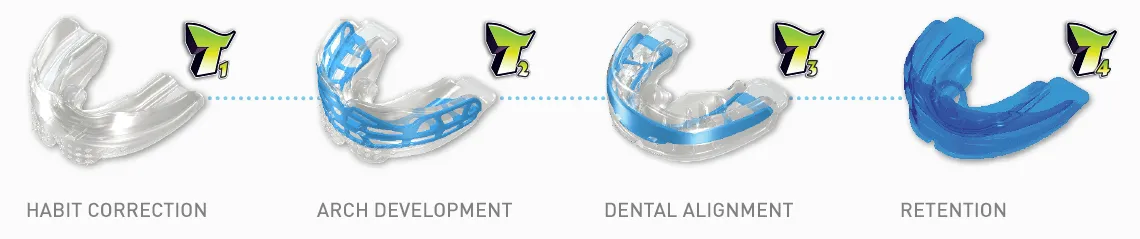
The Myobrace® System was developed in Australia by Myofunctional Research Co. It isn’t a single appliance but a sequence of soft, removable mouthpieces worn for an hour or two during the day and overnight, combined with daily exercises that retrain breathing, tongue posture and swallowing. The goal is to address the habits behind crowded teeth, not only the teeth themselves.
Myobrace® appliance sequence, image courtesy of Myofunctional Research Co.
The system moves through four stages: habit correction · arch development · dental alignment · retention.
Appliance + daily exercises
Soft and removable, worn at quiet times and overnight, with the exercises doing half the work.
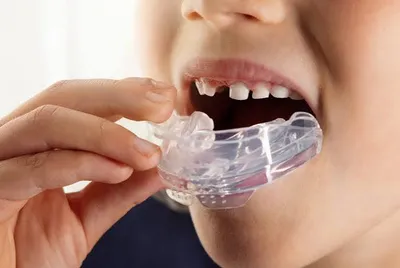
Each stage of the Myobrace® System uses a different appliance, designed to be worn comfortably during quiet time at home and overnight. It comes out for meals and school, and most children get used to it within a few nights.
The appliance is only half the treatment. Children also do short daily Myobrace® Activities: simple exercises for nose breathing, lip closure, tongue posture and swallowing, taking two to three minutes, twice a day. Parents of younger children join in, which makes it a shared routine rather than another chore.
How consistently the appliance is worn and the exercises are done has the biggest effect on results, so it’s worth being honest about what your family can realistically manage before starting.
Raising it at Point Cook
First, an honest assessment.
If your child’s breathing, sleep or crowded teeth worry you, raise it at a visit to our Point Cook clinic. It doesn’t commit you to anything. It’s a conversation, an examination and a clear next step, which might be a different approach, waiting and reviewing, or a referral to a specialist. Ask us whether Myobrace® is available and suitable for your child.
01 / ~15 mins
We listen first.
We start with what you’ve noticed at home: sleep, breathing, eating, what other dentists have said and what prompted the visit. Your child can play, draw or sit on your lap.
02 / ~10 mins
A gentle look.
We watch how your child breathes at rest, where their lips and tongue sit, how adult teeth are coming through, the shape of the upper arch and the bite. Nothing invasive, and nothing that needs them to sit still for long.
03 / ~10 mins
A straight answer.
If we see signs that myofunctional therapy could help, we’ll explain what we noticed, what treatment involves and whether it’s available here or through a referral. If we don’t, we’ll say so. If a specialist referral would suit your child better, that’s what we’ll recommend.
04 / Your decision
No pressure to decide today.
Most parents go home, talk it over and come back when the timing is right. We’ll give you a summary of what we discussed, including the option to leave things for now and review in six months.
Self-selecting, no pressure
Who it usually suits, and who it doesn’t.
Myobrace® isn’t right for everyone, and it’s better to know that early than after you’ve started.
Likely a good fit
This is probably for you if…
·You’re the parent of a child aged three to fifteen who mouth-breathes, snores or has crowded teeth coming through.
·You’re a teenager whose adult teeth are still settling; Myobrace® for Teens may suit, alone or with braces.
·You’re an adult with snoring, mild sleep-disordered breathing, jaw discomfort or long-standing habits; Myosa® appliances come from the same family.
·You’d like to address what’s causing crooked teeth or breathing problems, not only the symptoms.
·You can commit to daily exercises and overnight wear, with small, steady effort.
·You want a dentist to tell you honestly whether it suits you or your child, including when it doesn’t.
Probably not
This probably isn’t for you if…
·You want a quick fix. This is gradual and takes months, not weeks.
·Daily wear and exercises won’t fit your household right now. That’s fine; you can come back when they will.
·The problem is more complex than habits and growth. Some children need a different or specialist approach, and we’ll tell you if so.
·You want a finished orthodontic result without ongoing effort; Myobrace® and Myosa® both need daily participation.
·You’d prefer to start with braces or aligners. That’s a valid choice too, and we can discuss it with you.
Questions, plain answers
Myobrace questions parents ask.
The ideal time is roughly between six and ten, when the first adult teeth are arriving, the jaw is still growing and habits haven’t fully set. That’s when prevention can do the most. Earlier tends to be easier, but nothing suddenly stops at eleven.
It can still help after fifteen. Myobrace® for Teens is used as the last adult teeth come through, sometimes with braces and sometimes instead of more extensive treatment. For adults, the Myosa® System (from the same Australian company) is used for myofunctional therapy, mild sleep-disordered breathing, jaw joint problems, grinding and snoring. The assessment, not your child’s age, decides whether it fits.
Sometimes, but not always, and we’ll be upfront about that. Myobrace® targets the habits and growth patterns that lead to crowding. For some children that means less correction later; others still need braces or aligners, but with better habits underneath. Results vary, so ask our Point Cook team what’s realistic for your child.
For children it usually runs through the active growth years, often around eighteen months to three years, depending on age, the habits involved and how consistently the daily exercises are done. Teens and adults follow different appliance sequences, and a dentist can give you a realistic timeframe after an assessment.
No. A Myobrace appliance is a soft, pre-formed mouthpiece that isn’t fixed to the teeth and doesn’t need tightening. Plates and expanders are different appliances that work mechanically on the teeth or jaw, while Myobrace works mainly on breathing, tongue and swallowing habits. Our Point Cook team can explain which approach, if any, suits your child.
Usually one to two hours during the day, often while reading or watching TV, plus overnight while sleeping. It isn’t worn during meals or at school. Compared with braces, it’s much less visible and much less a part of your child’s day outside home.
The appliances are soft and designed to be comfortable. The first night or two can feel strange, as any new mouthpiece does, and most children settle within a few nights. There are no brackets, wires or tightening appointments. If one is genuinely uncomfortable, the dentist who supplied it can adjust or replace it.
This matters more than anything else: results depend on the appliance being worn and the exercises being done. That’s why it’s worth talking through what your family can realistically keep up, not just whether it’s clinically suitable. If now isn’t the right time, waiting six months is a perfectly good answer.
Costs depend on the treatment path, which varies too much for a phone estimate to be accurate. Ask our team whether Myobrace® is available and suitable for your child and, if it is, for a written plan with the total cost before you decide. Some parts may be claimable on private health extras, depending on your cover, and we offer on-the-spot HICAPS claims. The CDBS doesn’t cover orthodontic appliances, but an eligible child’s check-ups and basic care can be bulk-billed under the Child Dental Benefits Schedule, up to $1,158 over two calendar years (or $1,132 if their two-year period began in 2025). We can check what’s left of your child’s balance. Afterpay, Zip, Humm and SuperCare are also available.
When a child breathes through their mouth day and night, their lips stay apart and the tongue rests low instead of against the palate. Because the tongue helps shape the upper jaw from inside, the jaw can develop narrower, leaving less room for adult teeth, which then tend to come through crowded. Mouth breathing is also linked with poor sleep, daytime tiredness and changes in facial growth. Improving the breathing pattern early gives the jaw a better chance to grow into the space the teeth need.
Book a visit at Magical Smiles Point Cook online, or call (03) 8338 1515, and ask whether Myobrace® is available and suitable for your child. If your child hasn’t seen us before, our first visit page explains how we begin. We’ll be honest: if myofunctional therapy could help, we’ll explain why and what the next step is, and if not, we’ll say so. You’ll leave with a clear next step and no obligation.
Find us in Point Cook
Ask about Myobrace® at our Point Cook clinic.
Bring your questions about Myobrace® to Magical Smiles Point Cook, 220 Point Cook Road, Monday to Saturday from 9:00 am to 5:00 pm. Our team can tell you whether it’s available and suitable for your child. If a sister Magical Smiles clinic is closer to home, you’ll find it under Our locations.
Need help affording care? SuperCare may be an option.
In some circumstances the ATO may approve early release of superannuation on compassionate grounds for clinically necessary dental treatment. SuperCare can help with the application. Approval depends on your circumstances and isn’t assured, and early release may affect your retirement savings.
Book a visit at Magical Smiles Point Cook, 220 Point Cook Road, or call us to ask whether Myobrace® is available and suitable for your child. Afterpay, Zip, Humm and SuperCare are available.